
Zero Coal Dust Foundry: A Practical Guide to Eliminating Coal Dust from Green Sand
By Vijay Gurunath, Managing Director — Refcoat Chemicals | March 2026

Why "Zero Coal Dust" Is Now a Realistic Goal
Five years ago, suggesting that a foundry could operate without coal dust would have been met with skepticism. Coal dust has been part of the green sand recipe since the beginning of mechanised foundry production. It's cheap, it's available, and everyone knows how to use it.
But the landscape has changed. CBAM regulations are putting a price on coal dust combustion emissions. OEM customers are asking for lower-carbon supply chains. Dust management and workplace safety regulations are tightening. And perhaps most importantly, a commercially proven alternative now exists that doesn't require foundries to sacrifice quality or take on production risk.
This article is a practical guide — not a theoretical argument — for foundries that want to explore eliminating coal dust from their operations.
Step 1: Understand What Coal Dust Actually Does (and Doesn't Do)
Coal dust serves one primary function in green sand: it combusts when molten metal enters the mould, creating a lustrous carbon gas layer that prevents metal-sand fusion. This is what gives castings their surface finish and prevents burn-on defects.
Everything else coal dust does is a side effect — and most of those side effects are negative: backing sand temperature rise, premature water evaporation, bentonite degradation, VOC emissions, dust hazards, and CO2 generation.
The goal of a zero coal dust foundry isn't to eliminate the non-wetting barrier. It's to achieve that barrier through a different mechanism — one that doesn't produce the destructive side effects.
Step 2: Choose the Right Alternative
Nanokarb is a nanotechnology-based carbon additive that creates a non-wetting barrier at the mould-metal interface through ceramic nanoparticles, not through combustion. It has 0% volatile matter at 400°C, so the chain reaction that makes coal dust problematic never starts.
Key practical details for your planning:
Replacement ratio: 1 kg Nanokarb replaces 2 kg of coal dust. If you currently use 30 kg of coal dust per batch, you'll transition toward 15 kg of Nanokarb per batch (the exact ratio is calibrated during the assessment phase).
Dosage: 0.075% per batch, added through your existing hopper or alongside your current coal dust during the transition period.
Grade: Nanokarb is supplied as a single universal grade worldwide. There's no grade selection decision to make.
Equipment: None required. If you have a spare hopper, use it. If not, Nanokarb can be loaded into your existing coal dust hopper and dosed together during the transition.
Step 3: The Transition Method — Gradual, Not Sudden

No experienced foundry engineer would switch a key raw material overnight. The transition to zero coal dust follows a controlled, phased approach:
Week 1-2: Baseline and assessment. Refcoat assesses your sand system — current coal dust usage, bentonite levels, sand properties, rejection rates, and system circulation rate. We model your system using ForeCAST and predict the timeline and deliverables for your specific foundry.
Week 3-6: Parallel dosing. Nanokarb is introduced alongside your existing coal dust. As Nanokarb enters the system and begins circulating, coal dust additions are gradually reduced. You monitor the transition through standard sand testing — LOI, active clay, compactability, permeability. The predictions from the assessment phase give you specific benchmarks to check against.
Week 6-12: Coal dust phase-out. As Nanokarb becomes the dominant carbon source in your system (visible as a steady rise in LOI and stable or improving surface finish), coal dust can be reduced to zero or near-zero. The exact timeline depends on your system size and circulation rate — smaller systems transition faster.
Week 12+: Steady state. Your foundry operates without coal dust. Nanokarb is your sole carbon additive. Bentonite consumption will have dropped by 10-30% as a secondary benefit of eliminating the combustion chain reaction.
Step 4: What Changes and What Doesn't

What changes:
- Carbon additive switches from coal dust to Nanokarb
- Carbon consumption drops by 50-80%
- Bentonite consumption drops by 10-30%
- CO2 emissions from green sand drop by 50%+
- Dust levels in the plant reduce significantly (Nanokarb is non-explosive)
- Surface finish improves (typically visible within 20 days)
- Shot-blasting time reduces
What doesn't change:
- Your sand plant equipment
- Your moulding line
- Your metal composition or melting process
- Your core-making process
- Your basic sand testing routine (same parameters, same labs)
- Your bentonite supplier or grade (though you'll use less)
Step 5: Monitor and Verify
Throughout the transition, track these metrics:
LOI (Loss on Ignition): Should increase as Nanokarb replaces coal dust (Nanokarb has 85% LOI vs coal dust's 85-95%, but at half the dosage, the system LOI profile shifts).
Active clay: Should stabilise or increase, because bentonite is no longer being degraded by combustion heat.
Surface finish: Measure RA values on sample castings at regular intervals. Expect improvement within the first 20 days.
Rejection rate: Track by defect type. Sand-related defects (scabbing, erosion, blowholes, burn-on) should decline first.
Carbon consumption: Track total kg of carbon additive per batch. This is your primary cost metric.
What Real Foundries Have Achieved
Rajmane Industries introduced Nanokarb alongside MouldMax across their sand system. The results: bentonite consumption dropped from 1.1% to 0.58%, coal dust consumption fell by 50%, and the persistent mould leak problem was eliminated entirely. They continue to run Nanokarb as their standard carbon additive.
A large Indian automotive foundry producing 7,000 MT/month of cylinder blocks and heads on high-pressure moulding lines cut coal dust from 30 kg/batch to 15 kg/batch — a straight 50% reduction — while adding just 3 kg of Nanokarb per batch. Bentonite dropped from 50 kg to 37 kg per batch (26% reduction). Net monthly raw material savings: over ₹24 lakhs, with annual savings exceeding ₹2.9 crores. CO2 emissions from the green sand process fell by 590 MT/month.
A European foundry in Sweden running at 450 MT/month and 1,600°C pouring temperatures completed a phased transition from coal dust premix to 100% Nanokarb over 36 circulations. Carbon consumption dropped by 52.7%, bentonite by 13.9%, and CO emissions at the mould fell from 87 ppm to 28 ppm — a 67.8% reduction. Surface finish improved visibly and was maintained one month after the trial concluded.
An engine block foundry running a controlled trial over 41 circulations achieved a 50.7% reduction in carbon additive — from 13 kg to 6.4 kg per batch — with no mould coating required. Surface roughness (RA value) improved from 12.5–25 µm to 6.3–12.5 µm, and shot-blasting time dropped from 6 minutes to 5 minutes per cycle.
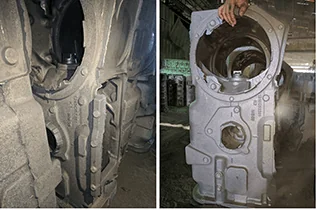
Surface finish progression with Nanokarb — actual casting results
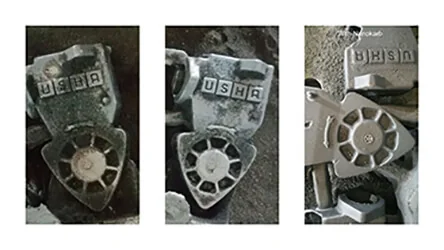
Engine block surface finish — before and after Nanokarb
The pattern across these foundries is consistent: 50%+ coal dust reduction, 10–30% bentonite savings, measurable surface finish improvement, and a transition timeline of 6–12 weeks with no equipment changes.
Getting Started
The transition from coal dust to zero coal dust is not a leap of faith. It's a structured, data-driven process with predictable outcomes. Refcoat provides a free assessment that models your specific sand system and predicts exactly what will happen — and when.
If the predictions don't match reality, you stop. But in our experience across foundries in India and the EU, they do.
Start Your Zero Coal Dust Transition
Request a free assessment. We'll model your sand system and show you exactly what will happen — and when.
Request a Free AssessmentRelated: Nanokarb | Nanokarb vs Coal Dust | Carbon Footprint of Coal Dust | Future of Green Sand